
" I believe the markets are rigged. Okay? There you go. I
also think that you are part of the rigging."
The argument, debates have a more formal
structure, between Mr. Katsuyama and Mr. O'Brien on CNBC three weeks ago
centered on speed and information. Having stepped right from the pages of
Michael Lewis' best-selling book Flash
Boys, Brad Katsuyama asserts
that stock exchanges should fairly price trades between fast and slow traders.
He added that specifically the market would accomplish this through the
information it uses to fairly price trades. Then Mr. Katsuyama turned to the
President of BATS, a stock exchange founded in 2005 and asked where BATS Global
Markets got the information it used to price trades in their matching
engine.
The source of their information mattered. Why? Because, as BATS Global Markets Inc. knew, stock exchanges that got their pricing information from SIP, or the Securities Information Processor, were easily outpaced by the high frequency traders. Basically, the exchange's view of the market is slower than that of the fastest traders, so the high frequency firms would be able to take advantage. Although Mr. O'Brien explained they use high-speed data to price trades, BATS was quick to correct him that two of its exchanges use the SIP. This admission of vulnerability to front-running emphasizes the importance of imperceptible amounts of time. In this amount of time, a high frequency trading firm would be able to commit both crimes Lewis had described: front-running and slow market arbitrage. Were HFTs a pestilence or had they contributed to the functioning of a modern market place?
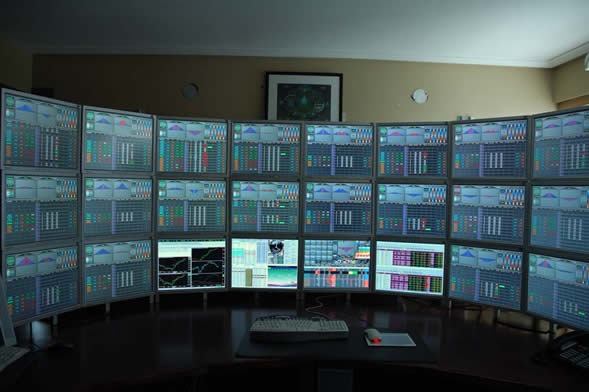 |
| This is the room where Agent Smith sees and front-runs your sale of MTRX. |
After waiting patiently to reply, Mr. O’Brien championed market improvements attributed to high
frequency traders. “15 years ago the spread between the best offer to buy and
sell was $.12 or $.25, now it’s $.01. 15 years ago what an institutional
investor paid Brad at RBC to execute his trade was $.06, now it’s 90-95% less
than that.” The President of BATS Global Markets was explaining that bid-ask
spreads (the highest price to buy for a buyer and lowest price to sell for a
seller) have become tighter due to HFTs. The smaller the spread, the more
likely trades are to occur. He also mentions that the increased trade volumes
have lowered transaction costs. Consider that HFT was responsible for 50% of
equity trading volume in 2012.(Check out the only article you need to read about HFT trade volume since 2005)
Brad agreed that computerized trading has had positive effects for
markets. The argument for HFT lowering transaction cost is generally seen as stronger than it increasing liquidity. As topics for later discussion show, namely the Flash Crash, computerized
trading can quickly deplete liquidity in a market. Next time, I'll look at the mechanics of an electronic trade and the short blooper reel of algorithmic, electronic trading.
Shameless plug for Brad Katsuyama’s new
exchange: IEX gets its information from direct feeds, but slows down HFTs so
that they lose their speed advantage, or rather, and HFT cannot front-run
another order in their exchange. It will be a difficult job keeping HFT firms from figuring out a means of exploiting the IEX system.

No comments:
Post a Comment