Finance

Wednesday, April 30, 2014

For every argument lauding electronic trading’s contributions to efficiency, there is a blooper reel. One specific instance of algorithmic trading and HFT contributing to negative pressures on the market involved the biggest one-day decline in the history of the Dow Jones Industrial Index- although prices recovered within minutes.

Jumpin’ Flash Crash


Throughout the day of the Flash Crash, stock prices had been declining due to concerns over the European Debt Crisis. At 2:32pm, according to the SEC and CFTC joint report called “Findings Regarding the Market Events of May 6, 2010,” a large “fundamental trader” executed a sale of $4.1 billion worth of e-Mini, an equity index futures contract with a notional value of 50 times the S&P 500. The firm used an “automated execution algorithm” which targeted “an execution rate set to 9% of the trading. At first, the principle buyers of these securities were HFT firms. Since HFTs prefer to trade a lot of contracts without building up much inventory, they quickly sold those long positions. Remember the fundamental trader used an algorithm set to execute at 9% of trading volume, and the HFTs buying and selling would invariably increase volume. Therefore, the fundamental trader’s algorithm executed the sell order faster, completing it in about 20 minutes. The sudden imbalance of trades towards sales contributed to price declines and triggered pauses in many firms’ automated trade execution systems. In the “Lessons Learned” section of the joint report, the SEC and CFTC noted that algorithmic trading of a large sell order “can trigger extreme price movements” and can “quickly erode liquidity” in the marketplace.


Concluding thoughts and the future of fair markets and HFT                                     


In this blog’s most recent post, I highlighted the efficiency of electronic trading. From lower bid-ask spreads to smaller trade sizes, electronic trading has made the movement of capital within markets faster and, some argue, easier. Turning to high-frequency trading, this practice has shown what should be an assumption of well-functioning markets: without regulation, firms with sufficient capital will find the most expedient ways of turning a profit. The tool itself is not the source of evil, in fact, it might have contributed to lower commissions. All of this has been mentioned in earlier blog posts. However, the system is not without regulation.

Regulation NMS, or National Market System, made sure of four things, one of which is directly relevant to the current discussion:
  • Order Protection- this was described earlier as NBBO, or the right of investors to buy or sell at the best price they can that exists in the markets. (Source: Investopedia)

 This rule focuses on protecting the investor, specifically giving the smaller investors the same rights as institutional investors.  As we have seen in dark pools, best described in the eponymous work Dark Pools by Scott Patterson, the NBBO is not always followed to the letter in practice. The answer here is not the elimination of a practice, which if harnessed, could potentially increase liquidity in the market. The answer is regulation.

Keynes’ mention of animal spirits referred to human behavior which affected the performance of the general market. Shiller’s book of the same name later added to this discussion of reigning in the excesses of human nature. Shiller and Akerlof suggested government regulation as the answer, and this author agrees. Brad Katsuyama made the most insightful point that HFTs can be slowed down in order to reduce their advantage on the individual or even institutional investor. His exchange, IEX, may not be perfect, and Michael Lewis mentions that it has found HFTs probing its weaknesses. Brad Katsuyama, however, is not the answer.

"Allen Iverson is the answer, not me."
Regulation should be devoted to curbing the ability of HFT firms to front-run orders. The slow-market arbitrage that HFTs take advantage of should force the exchanges themselves to use the quickest feeds processed by the fastest technology, so that the information presented by the exchanges is accurate and up-to-date. Since regulation needs only to address the front-running, and eventually the relationship between lack of transparency and lack of fairness within dark pools, the SEC needs only find a way to slow down HFTs or restrict their ability to see customer orders before they reach all the exchanges they are meant to. (Source: Animal Spirits by Shiller and Akerlof)

The arbitrage between slow-updating exchanges can and should be exploited to create more efficient markets, but when that becomes predatory, efficient markets can become unfair markets. For the typical  investor, remember these firms will typically try to exploit the differences in cents between trade orders, and you should be working with a much higher margin of safety than that. For traders there has been no better advice than “follow the white rabbit.”


Happy trails and may your trades be of the highest frequency

Monday, April 28, 2014

"Talk of the devil, and his horns appear"

In the Catholic Church, the Promoter of the Faith in the process of canonization (or sainthood) argues against the candidate being considered for the honor. Given recent media attention in HFT, these quants need their own promotor fidei. Consider first, high-frequency trading is a small (in number of firms and capital) subsection of electronic trading. Although recent media attention towards electronic and algorithmic trading has focused on the negatives these advances in global markets have produced more efficient outcomes as well.


Larry Harris of USC Marshall Business School has provided an excellent introduction to the digitization of markets and trading. His account is balanced between trends, benefits and parasitic HFT strategies. As I have already discussed the pitfalls of high-frequency trading and the Flash Crash, this post will focus on the benefits of high-speed trading. He attributes the success of electronic exchanges and trading to efficiency. Harris cites a number of benefits, including:
  • ·         Faster executions
  • ·         Decreasing trade sizes
  • ·         Falling bid-ask spreads
  • ·         Increased volume
  • ·         Decreasing large trade costs (for 1M shares on $30 stock)
  • ·         Increased liquidity in the markets

Faster executions, decreasing trade sizes, falling bid-ask and increasing volume: The implication with this and several others on the list is that electronic trading increases liquidity in markets. Not only can buyers and sellers complete trades faster, smaller orders can be processed than before. Where in 2004 trades took 15-25 ms, in 2011 they took <3 ms.


Similarly, trade sizes on the NYSE decreased from 800 shares to 300 between 2004 and 2011. The former is an improvement in efficiency, and superficially, the latter is an improvement in liquidity, however, liquidity is not necessarily defined by order sizes. Low trade sizes and high volume are typically used to test liquidity of an asset, but liquidity is really the ease of buying an asset in the market. HFT front-running actually decreases liquidity although it increases volume and encourages lower trade sizes (remember the feeler orders sent out by HFTs from an earlier post?).

Bid-Ask spreads have lowered from 7 cents in 2001 to under 2 in 2013. This term refers to the difference between the lowest price a seller is willing to sell a security and the highest price that a buyer is willing to pay for that same security. Lowering the bid-ask means the seller and buyer are closer to making a deal. Often, firms offering investment products will look at median bid-ask spreads to see how the product is trading and guide their product promotions.

One problem remains, most of Harris’ argument focuses on electronic trading, but what of HFT in particular?


During the course of Peter Nabicht’s public beating on CNBC, he made several interesting points about high-frequency trading. For one, HFTs are not designed to game the market, they are more efficient processors of information and trade executions. The way they are used has brought up issues of scalping and “rigged markets,” as Brad Katsuyama asserts. Mr. Nabicht is absolutely correct in saying it’s the misuse of technology. Front-running does not simply happen when an HFT is waiting at your closest stock exchange for your order so that it can beat you to the other exchanges.

Enter the Dark Pool: (for more on this topic, read Scott Patterson's WSJ articles and book called Dark Pools ) Institutions have dark pools ostensibly because it allows large investors to buy or sell big without others noticing and compounding the upward or downward effect on the stock. As detailed in Flash Boys, Rich Gates of TFS Capital, noticed that the rates of internalization (or percentage of customers’ orders filled within the dark pool of a bank) were exceptionally high given their small share of the overall market. Mr. Gates sent two orders, one was a buy order sent to a dark pool at $100.05 for Chipotle and the other was a sell order sent to a public stock exchange at $100.01 for Chipotle. Due to Regulation NMS and the NBBO stipulation, he should have been able to sell himself the Chipotle shares for $100.01 because it was the best offer available. However, almost immediately, he had sold his shares for $100.01 and bought shares for $100.05. HFTs, he learned after repeated tests, were able to front-run within the dark pools. They could see the big trades being made and front-run them to the public exchanges. Once again, like in Mr. Nabicht’s defense of HFT, we see that it is the misuse of technology which makes HFT the villain.

Maybe you are a buy and hold investor who has values his investments with a margin of safety well above 4 cents, and Benjamin Graham would certainly give you a “check plus,” but for the sake of fair markets, how can we reign in the overwhelming speed of the HFT, and should we?

Next time: This blog bids its readership a fond farewell with a discussion of the Flash Crash, Reg NMS, and of course, our own “animal spirits.”


Title courtesy of Samuel Taylor Coleridge (1772-1834)

Monday, April 21, 2014

Look who's rigging the markets now


" I believe the markets are rigged. Okay? There you go. I also think that you are part of the rigging."

The argument, debates have a more formal structure, between Mr. Katsuyama and Mr. O'Brien on CNBC three weeks ago centered on speed and information. Having stepped right from the pages of Michael Lewis' best-selling book Flash Boys, Brad Katsuyama asserts that stock exchanges should fairly price trades between fast and slow traders. He added that specifically the market would accomplish this through the information it uses to fairly price trades. Then Mr. Katsuyama turned to the President of BATS, a stock exchange founded in 2005 and asked where BATS Global Markets got the information it used to price trades in their matching engine.  

The source of their information mattered. Why? Because, as BATS Global Markets Inc. knew, stock exchanges that got their pricing information from SIP, or the Securities Information Processor, were easily outpaced by the high frequency traders. Basically, the exchange's view of the market is slower than that of the fastest traders, so the high frequency firms would be able to take advantage. Although Mr. O'Brien explained they use high-speed data to price trades, BATS was quick to correct him that two of its exchanges use the SIP. This admission of vulnerability to front-running emphasizes the importance of imperceptible amounts of time. In this amount of time, a high frequency trading firm would be able to commit both crimes Lewis had described: front-running and slow market arbitrage. Were HFTs a pestilence or had they contributed to the functioning of a modern market place?
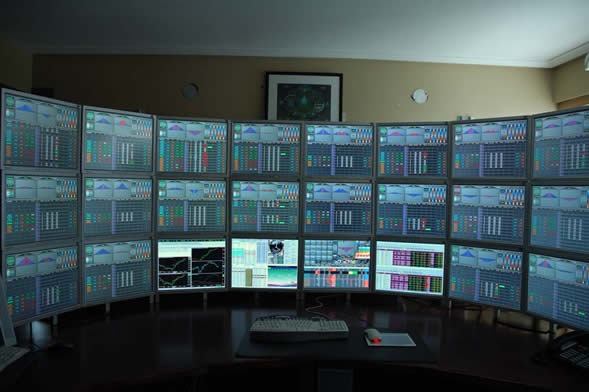
This is the room where Agent Smith sees and front-runs your sale of MTRX.
After waiting patiently to reply, Mr. O’Brien championed market improvements attributed to high frequency traders. “15 years ago the spread between the best offer to buy and sell was $.12 or $.25, now it’s $.01. 15 years ago what an institutional investor paid Brad at RBC to execute his trade was $.06, now it’s 90-95% less than that.” The President of BATS Global Markets was explaining that bid-ask spreads (the highest price to buy for a buyer and lowest price to sell for a seller) have become tighter due to HFTs. The smaller the spread, the more likely trades are to occur. He also mentions that the increased trade volumes have lowered transaction costs. Consider that HFT was responsible for 50% of equity trading volume in 2012.(Check out the only article you need to read about HFT trade volume since 2005)

Brad agreed that computerized trading has had positive effects for markets. The argument for HFT lowering transaction cost is generally seen as stronger than it increasing liquidity. As topics for later discussion show, namely the Flash Crash, computerized trading can quickly deplete liquidity in a market. Next time, I'll look at the mechanics of an electronic trade and the short blooper reel of algorithmic, electronic trading. 

Shameless plug for Brad Katsuyama’s new exchange: IEX gets its information from direct feeds, but slows down HFTs so that they lose their speed advantage, or rather, and HFT cannot front-run another order in their exchange. It will be a difficult job keeping HFT firms from figuring out a means of exploiting the IEX system. 


Tuesday, April 15, 2014

The Nuts and Volts of High Frequency Trading


Michael Lewis' Flash Boys ends with "all that one needed to discover the truth about the tower was the desire to know it." So, although parts of the book will be discussed throughout, I advise you to read the book- I would not hold my breath for another movie. 


First, a definition: high frequency trading, according to Investopedia, is "a program trading platform that uses powerful computers to transact a large number of orders at very fast speeds." Essentially, someone creates a rule or algorithm, and the algo searches through an incomprehensibly large stream of data to find information that it can turn into trades based on the rule. Logically, one could conclude that due to increased trading volumes- HFT was responsible for over 50% trades in 2012- that the markets are more liquid, spreads are lower, and technology is being leveraged to create new financial powerhouses like Citadel.

Before we form any opinions, let's see how electronic trading has helped HFT firms secure an advantage. When an order to buy, say 10,000 shares of a company, is placed, all those shares won't necessarily be on the same exchange. Regulation NMS requires brokers to trade at the National Best Bid and Offer, or the lowest ask and the highest bid for their customer. The regulation, does not however, specify to what exchange the trade goes to. Often a larger order will not be able to find all the shares it wants to buy or sell on one exchange. The trade can fulfill a portion of its shares on NYSE, a portion on NASDAQ and a portion on BATS, etc. When a broker places the bid to buy these, a signal is sent to the exchanges that it wishes to trade on, but due to differences in distances to each exchange's servers, the orders do not arrive at precisely the same time with differences in milliseconds, 300 of which it takes for you to blink or for Gene Wilder to steal your chess piece. 
Here is where HFT firms have the advantage. Their computers can see, process and act on this information (from the first exchange it gets to) before your trade reaches the other exchanges. This is the first charge that Lewis levels at HFT firms, and he calls it "electronic front-running." The second offense, according to Lewis, is "slow-market arbitrage," and that is when two stock exchanges (or more) have different prices for the same security. For example, say you wanted to place a big buy order for Yum! Brands because you sincerely believe the market has not priced the unbounded future success of Taco Bells' Waffle Taco and the Mountain Dew Kickstart Black Cherry into the stock price of Yum! Brands. If you place a big order, which occurs on the NYSE, that will bump up the price of Yum! Brands slightly and for long enough that HFT firms can exploit the differences in prices across exchanges. The third offense is the focus of a future posting.

So, these algorithms can process information faster than a human blink, and eliminate arbitrage, on the other hand, they could give HFT firms an unfair advantage (by seeing big trades reaching one exchange and acting on them before they reach the other exchanges). Please think about this, do some research, and we will meet right back here soon for a blow-by-blow recap of the Brad Katsuyama and Bill O'Brien fight on CNBC.

links to various articles:

http://www.forbes.com/sites/billconerly/2014/04/14/high-frequency-trading-explained-simply/

http://www.cnbc.com/id/101552392

http://www.nytimes.com/2014/04/14/opinion/krugman-three-expensive-milliseconds.html?action=click&module=Search&region=searchResults&mabReward=csesort%3Aw&url=http%3A%2F%2Fquery.nytimes.com%2Fsearch%2Fsitesearch%2F%3Faction%3Dclick%26region%3DMasthead%26pgtype%3DHomepage%26module%3DSearchSubmit%26contentCollection%3DHomepage%26t%3Dqry134%23%2Fhft%2F7days%2F&_r=0

x

Sunday, April 6, 2014

Irrational Exuberance in the Machine


Our decisions "can only be taken as the result of animal spirits- a spontaneous urge to action over inaction," said John Maynard Keynes, but nowadays the bears and bulls of the NYSE trading floor are being replaced by servers and trading is often governed by algorithms. Well, isn't this the natural progression, you might ask. 

The point is a valid one. In 1969, the American Stock Exchange found that errors in handwritten securities orders cost brokerage houses around $100 million. To put that in perspective, that same year Woodstock cost organizers $2.6 million. Point to computers.

On the other hand, questions have been raised about the way computers read the data they process so quickly. On April 23, 2013, a fake tweet from AP claiming the US President was injured removed $136 billion from the S&P 500 index in two minutes, although the market did recover by the end of the day. 
In 2008, a six-year old Chicago Tribune article about United Airlines' 2002 bankruptcy was mistakenly included with the daily news on the financial news site, Bloomberg. The error resulted in a drop in stock price from $12.30 to $3.00. 


Algorithms process unbelievable amounts of data quickly and spit out the results we built them for. These events highlight an important concept in computer science, "garbage in, garbage out." This blog will provide access to the dialogue about algorithmic trading, including Michael Lewis' Flash Boys and Scott Patterson's Dark Pools, in order to produce a more informed investor. Quality in, quality out.